The preneed landscape in North Carolina is changing faster than most funeral home programs have adapted to. The macro forces — cremation rates, demographics, carrier consolidation, and digital consumer behavior — aren't going to reverse. The NC funeral homes that thrive in the next five years will be the ones that understand what's actually happening and adjust their strategy accordingly.
Here's what Duane is seeing across North Carolina funeral home programs in early 2026.
The Cremation Mix Shift Is Permanent — And Still Moving
In 2010, the national cremation rate was roughly 40%. In 2026, it's approaching 65% nationally, with North Carolina tracking that trend closely. For funeral homes that built their preneed programs in the traditional-burial era, the math has quietly changed.
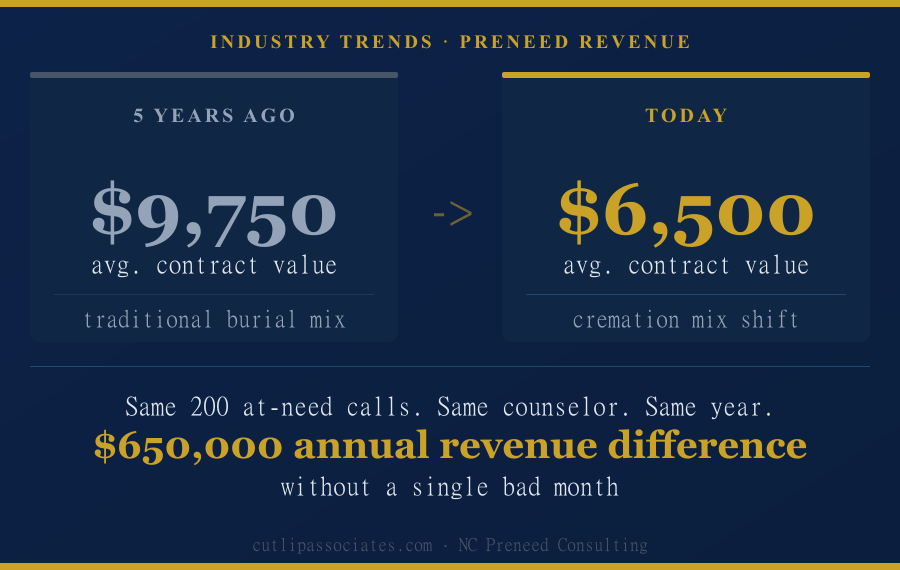
A traditional NC funeral home with 200 at-need calls was used to average preneed contracts of $8,500–$11,000. As cremation becomes the majority of their volume, average contract values have dropped to $5,500–$7,500 for many programs — even as they're writing the same number of contracts. That's a $600,000–$700,000 annual revenue difference that didn't require a single bad month to happen.
What this means for preneed strategy
- Volume targets need to be recalibrated — you need more contracts to produce the same revenue
- Cremation-with-services education is now essential — families don't automatically know a meaningful cremation service is possible
- Traditional burial should be actively presented, not passively offered — for families where it's appropriate, it represents dramatically better care and meaningfully higher contract values
- Younger prospect targeting matters more — families in their 50s and 60s are more likely to still be open to traditional arrangements than families in their 80s
Policy Growth Rates: What the Numbers Actually Mean for Funeral Homes
Preneed insurance policies accumulate value over time, but the growth rate and how it applies to the funeral home's receivable matters enormously — and many funeral homes don't fully understand what they've agreed to until it's time to collect.
Most preneed insurance products offer growth rates in the 2–4% annual range, applied to the policy's face value or accumulated value depending on the contract structure. A policy sold today for $8,000 with 3% annual growth will be worth approximately $10,800 in ten years. Whether that growth actually covers the funeral home's cost increase depends on how the assignment works — and on whether the policy is assigned at face value or accumulated value.
Age-banded pricing adds another variable. Preneed insurance premiums are calculated based on the insured's age at time of purchase. A 65-year-old and a 78-year-old purchasing the same $8,000 policy will pay very different premiums — and the older purchaser's policy may have a shorter accumulation period before it matures. For funeral homes with an older prospect pool, this affects both the counselor's conversation and the program's long-term revenue trajectory.
What this means in practice: Funeral homes that only track "contracts written" are missing the more important question: what will those contracts actually pay when they mature — and will that cover your costs at that time? Programs that track average contract growth rates alongside their own expense inflation have a much clearer picture of their preneed program's true long-term value.
The Boomer Opportunity Is Real — But Not What the Industry Expected
The demographic tailwind is genuine: the leading edge of the Baby Boomer generation turned 80 in 2026, and over the next 15 years they will drive a sustained increase in at-need call volume. That part of the prediction has proven true.
What the industry underestimated is how heavily boomers have embraced direct cremation and simplified services. A generation that marketed itself on self-determination has applied that to funeral planning too — and for many, that means the least expensive option with the least ceremony. Preneed counselors who expected to spend 2026 writing traditional burial plans for boomers are, in many cases, writing direct cremation plans at $3,500 instead of $12,000.
The opportunity is still there — but the conversation has to meet boomers where they are. The families who've watched parents go through traditional services and found them meaningful are still reachable. The families who've decided "cremation, nothing elaborate" aren't changing their minds because a counselor walked through a casket presentation. What moves them is a genuine conversation about what matters to their family and whether preneed accomplishes something they actually care about.
What's actually working with boomer prospects in 2026
- Leading with the family burden conversation — protecting adult children from decisions they're not prepared to make
- Presenting cremation-with-services as a real option, not an afterthought — boomers who haven't seen what a meaningful cremation service looks like are often open to it
- Shorter, more direct conversations — this generation has heard too many sales pitches to tolerate a long setup
- Targeting the 58–68 age range, not 75+ — younger boomers still have higher average contract values and longer accumulation periods
- Acknowledging the skepticism directly — the counselors getting traction are the ones who say "I know you've probably been pitched on this before" and mean it
Digital Lead Generation Has Permanently Changed the Funnel
Church seminars, direct mail, and community outreach remain effective in North Carolina — particularly in rural and suburban markets where community ties are strong. But the prospect funnel has fundamentally changed. A meaningful percentage of preneed prospects now research online before making contact, and some are specifically looking for the ability to initiate the process digitally.
NC funeral homes without a digital presence — or with a minimal, outdated website — are invisible to an increasing share of their prospect pool. This isn't a prediction; it's happening now. Preneed counselors report more first-contact inquiries from leads who "found them on Google" and fewer cold seminar attendees.
At the same time, the funeral homes that have combined strong community presence with digital visibility are seeing an additive effect — traditional seminar attendees who have also seen the funeral home's online presence arrive with higher trust and closer to a decision.
Practical implication: Digital doesn't replace community outreach in North Carolina — the personal relationship still closes preneed contracts. But digital absence is increasingly a barrier. A funeral home's website, Google Business Profile, and online reputation are now part of the prospect's evaluation process, whether the funeral home participates in that process or not.
What Strong NC Programs Are Doing Differently in 2026
Targeting younger prospects more aggressively
Seminar content and outreach targeting the 58–68 age range rather than the traditional 70+ focus. Younger prospects have higher contract values, longer policy accumulation periods, and higher average commissions.
Leading with cremation-with-service education
Not to push cremation — to help families understand that cremation doesn't have to mean no gathering, no story told, no meaningful goodbye. Many families who "just want cremation" have never been shown what a meaningful cremation service looks like.
Building a referral infrastructure
Relationships with elder law attorneys, financial advisors, Medicare/Medicaid specialists, and senior center directors who encounter preneed prospects and can make warm referrals.
Investing in counselor training and retention
The labor market for experienced preneed counselors is competitive. Funeral homes that invest in training, provide real support systems, and compensate fairly are retaining counselors. Those that don't are in a constant churn cycle.
Tracking the five KPIs consistently
Penetration rate, average contract value, conversion rate, cancellation rate, and at-need capture. High-performing programs know their numbers and adjust quarterly. Programs that only look at contracts written are managing blind.
NC Regulatory Environment: What's Changing
The North Carolina Board of Funeral Service's oversight of preneed programs — under N.C.G.S. Chapter 90, Article 13D — has grown more rigorous in recent years. Trust accounting requirements, record-keeping standards, and counselor licensing compliance are all areas where examination scrutiny has increased.
Key areas NC funeral homes should be reviewing in 2026:
- Current counselor licensing — preneed establishment and individual sales licenses must be current and on file
- Trust fund accounting — proper segregation and reporting per 21 NCAC 34D .0301
- Contract form compliance — all contract forms must be Board-approved per 21 NCAC 34D .0101
- Consumer disclosures — required disclosures at point of sale and in documentation
- Annual report filings — due to the Board and carrier trust requirements
The Fundamentals Haven't Changed
Cremation rates, carrier consolidation, and digital lead generation are real forces reshaping the preneed market in North Carolina. But the fundamental of what makes a preneed program succeed hasn't changed: a counselor who has genuine conversations with families about their goals, builds real relationships, follows up consistently, and serves families well.
The NC funeral homes that get those fundamentals right — and adapt their systems to the 2026 market — will look back on this decade as a time of significant growth, not decline.
Duane Cutlip is a Licensed Preneed Funeral Director serving independent North Carolina funeral homes. This article reflects what he's seeing in programs across NC in early 2026.
Talk to Duane — (919) 822-2010