Most funeral home owners can tell you how many preneed contracts they wrote last month. Very few can tell you what their conversion rate was, what their cancellation rate is running, or what percentage of preneed families they're capturing at-need. Those blind spots are costing programs thousands of dollars a year — often without anyone noticing.
Here are the five metrics every funeral home should be tracking — what they mean, what good looks like, and what it tells you when a number is off.
Penetration Rate
How to calculate it
Active preneed contracts ÷ at-need calls (prior 12 months)
This is the foundational preneed metric — a ratio of how many families you've pre-arranged compared to how many you're serving at need. A funeral home doing 200 at-need calls per year that has 100 active preneed contracts has a 0.5x (50%) penetration rate.
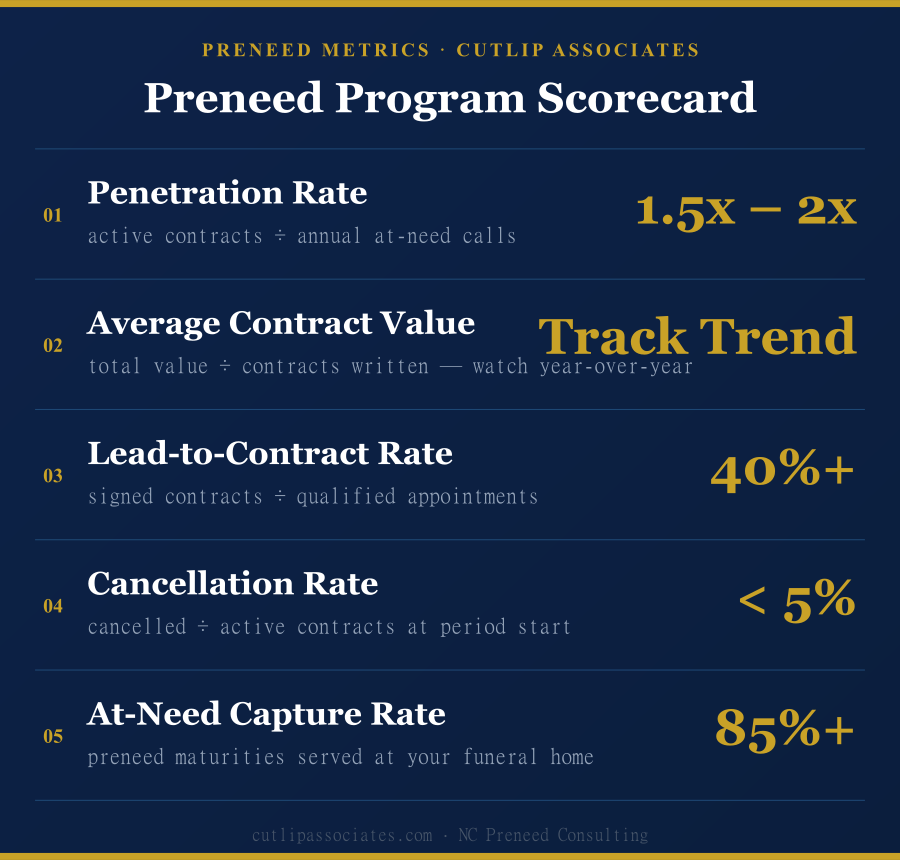
High-performing programs typically run 1.5x to 2x — meaning they have 1.5 to 2 times as many active preneed contracts as their annual at-need volume. That's not unusual for a mature program with consistent community outreach. Programs under 0.5x are capturing a small fraction of their market potential.
What a low number tells you: The program is either not generating enough leads, not converting leads to contracts, or losing contracts to cancellation faster than they're being written. You need to know which — the diagnosis determines the fix.
Average Contract Value
How to calculate it
Total contract value written ÷ number of contracts
This one is revealing, particularly when you track it over time. Average contract values have been under pressure for a decade as cremation rates have risen — cremation plans typically run $4,000–$7,000 while traditional burial plans run $10,000–$18,000 or more. A funeral home that was averaging $9,500 per contract five years ago might be averaging $6,800 today, with the same number of contracts written.
For a counselor writing 50 contracts a year, that $2,700 drop in average value equals $135,000 in revenue that evaporated without anyone realizing it.
What a declining number tells you: Your mix is shifting toward cremation, your families are selecting fewer add-on items, or both. This isn't necessarily bad — but it should be an intentional strategic reality, not an accident you discover two years later.
Lead-to-Contract Conversion Rate
How to calculate it
Signed contracts ÷ qualified appointments (prior 12 months)
High-performing counselors close 40% or more of their qualified appointments. Programs struggling with conversion often run 15–25%. The gap is usually not about the product — it's about the sales conversation. Scripts and pressure tactics produce low conversion and high buyer's remorse (which shows up later as cancellations). Consultative conversations about family goals and concerns close at a much higher rate.
Note the denominator carefully: qualified appointments, not raw leads. A funeral home that generates 200 leads but books 40 appointments has a lead-to-appointment conversion issue. A counselor who books 40 appointments and closes 8 has a presentation issue. These are different problems.
What a low number tells you: Training issue more often than a lead quality issue. If your counselor is sitting in front of motivated families and only closing 1 in 5, the conversation is breaking down somewhere — usually around objections or the ask.
Cancellation Rate
How to calculate it
Contracts cancelled in the period ÷ active contracts at start of period
Most programs target a cancellation rate under 5% annually. Rates above 8–10% are a significant problem — it means families are signing and then leaving. Common causes: buyer's remorse from a high-pressure sale, families relocating, program switching to a competitor, or simply inadequate follow-up that lets the relationship go cold.
This is a lagging indicator — the damage is done before the cancellation hits your books. A high cancellation rate traced to buyer's remorse usually means the conversion issue was resolved with the wrong technique. Closed, but not well.
What a high number tells you: Either the sales process is generating low-commitment contracts, the post-sale relationship isn't being maintained, or families are being poached. Review your 90-day cancellation cluster — if most cancellations happen within 90 days of signing, it's a sales process issue. If they're spread across years, it's a relationship maintenance issue.
At-Need Capture Rate
How to calculate it
At-need calls from preneed families ÷ total active preneed contracts maturing (deaths)
This is the ultimate measure of preneed value. When a preneed family needs to call, do they call you? High-performing programs capture 85%+ of preneed contract maturities. Programs with poor relationship maintenance — where the preneed counselor sold the contract and then the family never heard from the funeral home again — see capture rates as low as 50–60%.
The at-need capture rate also validates the business case for preneed investment. A program spending $80,000 a year on a preneed counselor that captures 90% of its maturities is building a locked-in future at-need pipeline. One capturing 55% is paying for a lead generation program that sends nearly half its leads to competitors.
What a low number tells you: The preneed relationship ended at the sale. Families didn't feel enough connection to the funeral home to call when the time came — or they didn't remember who they were supposed to call. Annual outreach, anniversary calls, and community presence matter as much after the sale as before it.
Using These Numbers Together
None of these KPIs should be read in isolation. A high conversion rate paired with a high cancellation rate means sales technique is overcoming family resistance — not building genuine commitment. A strong penetration rate with a low at-need capture rate means you have the contracts but not the relationships.
Together, these five numbers give you a complete picture of your program's health — from lead generation through the family's at-need call years later. If you don't know where your numbers are, that's the place to start.
Duane Cutlip is a Licensed Preneed Funeral Director serving independent North Carolina funeral homes. This article reflects his field experience working with programs across NC.
Talk to Duane — (919) 822-2010